Origins & processing
Natural, pulped natural, washed: Brazilian coffee processing explained for roasters
How post-harvest processing shapes Brazilian green coffee, what to ask your supplier and how to choose the right method for your blend.
Green Coffee · · 2 min read
Key points
- Processing describes what happens to the cherry between harvest and green coffee.
- Natural is widespread in Brazil; pulped natural sits in between.
- The declared method is a clue, not a guarantee: the sample decides.
01
Why processing matters
Between picking the cherry and filling a bag of green coffee, several steps affect bean moisture, lot uniformity and ultimately the cup. That is why processing is one of the first lines to read on a specification sheet.
Many Brazilian farms harvest mechanically or by strip picking, collecting cherries at different ripeness levels, so sorting and drying management become decisive.
02
Natural (dry process)
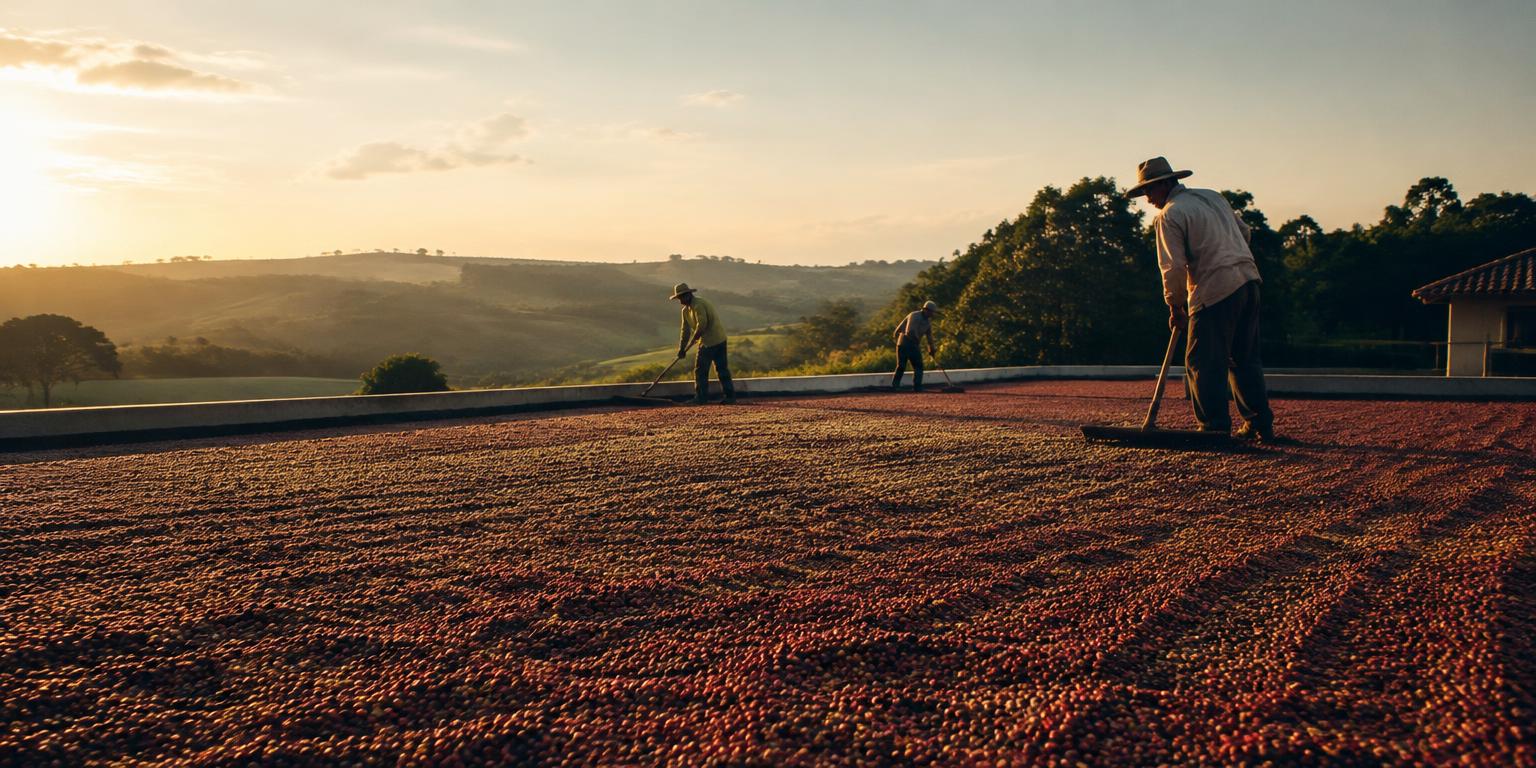
The whole cherry is dried in the sun on patios or in mechanical dryers, and only afterwards is the bean separated from skin and pulp. It is historically the most common method in Brazil, helped by a dry season during harvest.
Commercial descriptions often associate Brazilian naturals with body and sweetness, but results vary widely with ripeness, drying and storage. Always confirm with a sample.
The processing method guides the choice; the sample confirms it.
03
Pulped natural (cereja descascado)
The skin is removed mechanically, but part of the mucilage stays on the bean during drying. In Brazil it is known as ‘cereja descascado’ (CD) and sits between natural and washed.
Mechanical pulping often allows less ripe cherries to be separated before drying, which can help lot uniformity.
04
Washed and other methods
In washed coffee the mucilage is fully removed, usually through fermentation in water or mechanical removal, before drying. It is less common in Brazil than in other origins, but some producers offer it for specific lots.
More farms are experimenting with controlled fermentations. In those cases, ask for a precise description of the process: commercial labels are not standardised.
05
What to ask your supplier
To compare lots, ask for the processing method together with the other lot information.
- Declared method and, where available, drying details and timing.
- Moisture and water activity of the green coffee, when measured.
- Screen size and information on defects and sorting.
- Crop year and storage conditions.
- A sample from the same lot to check in your roaster.